WorkAboutProcessOpen my CVContact

Case study · 01

CineVerse Observatory

A guided scan that grows into an explorable, organized, and exportable taste universe.

Role
Product Designer & Full-Stack Developer
Year
2026
Platform
Responsive web app

The problem

Turning fragmented film, music, and saved-list behavior into one understandable taste profile.

Read the full context

Film and music enthusiasts need to discover content that fits their current mood, understand the patterns behind their choices, and organize what they have watched, saved, rated, or listened to. When these activities are split across search tools, watchlists, ratings, and playlists, recommendations lose context and saved content becomes an archive that does not explain how each item relates to the user’s taste. CineVerse addresses this fragmentation by bringing analysis, discovery, organization, and visual representation into one connected journey.

The idea

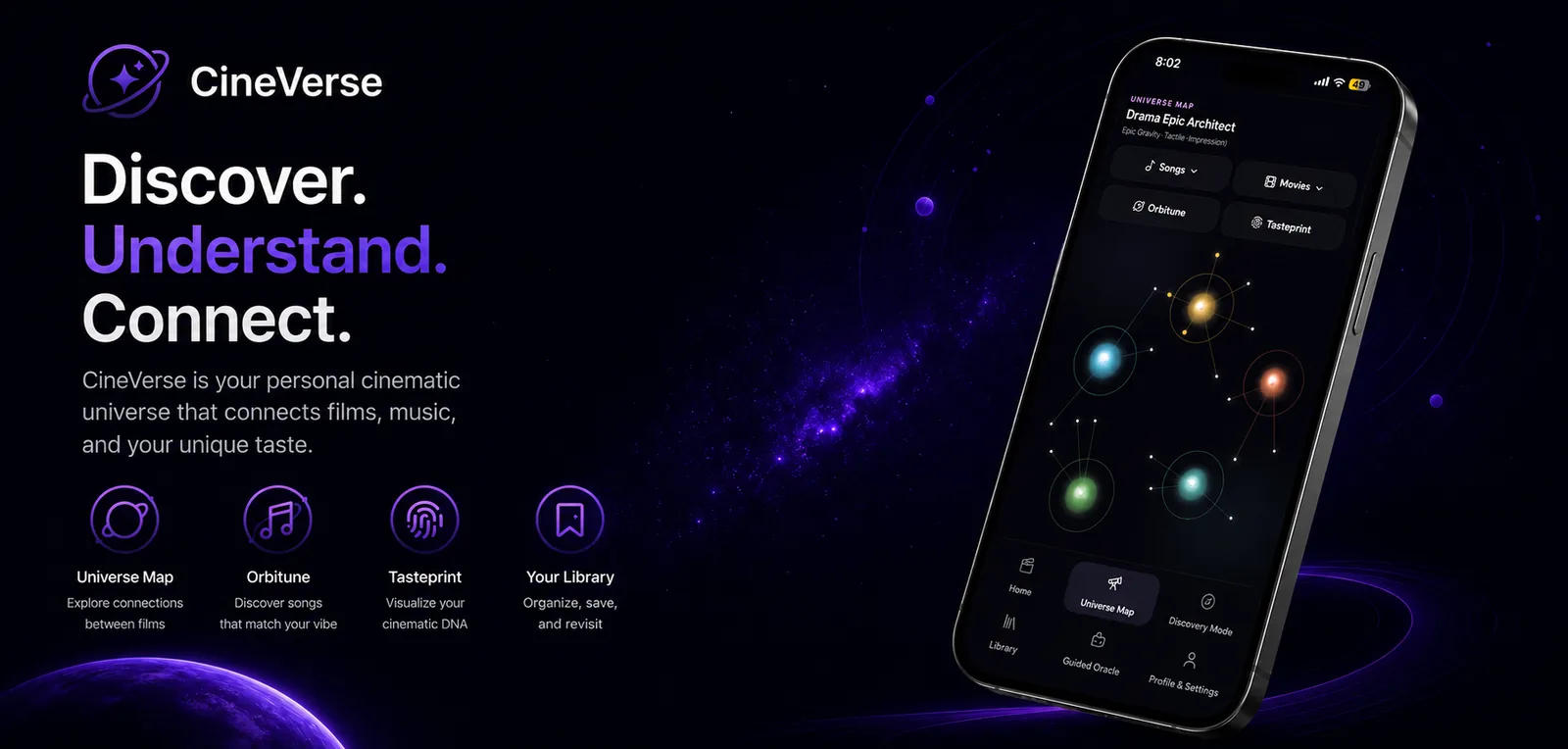
CineVerse turns a guided taste scan into a secure, persistent discovery system where analysis, recommendations, film and music exploration, and saved collections reinforce one another.

  • Product Strategy
  • UI/UX Design
  • React & TypeScript
  • NestJS API
  • Prisma & PostgreSQL
  • Auth & Security
  • External APIs
  • Automated Testing
  1. 01

    Taste Scan & DNA

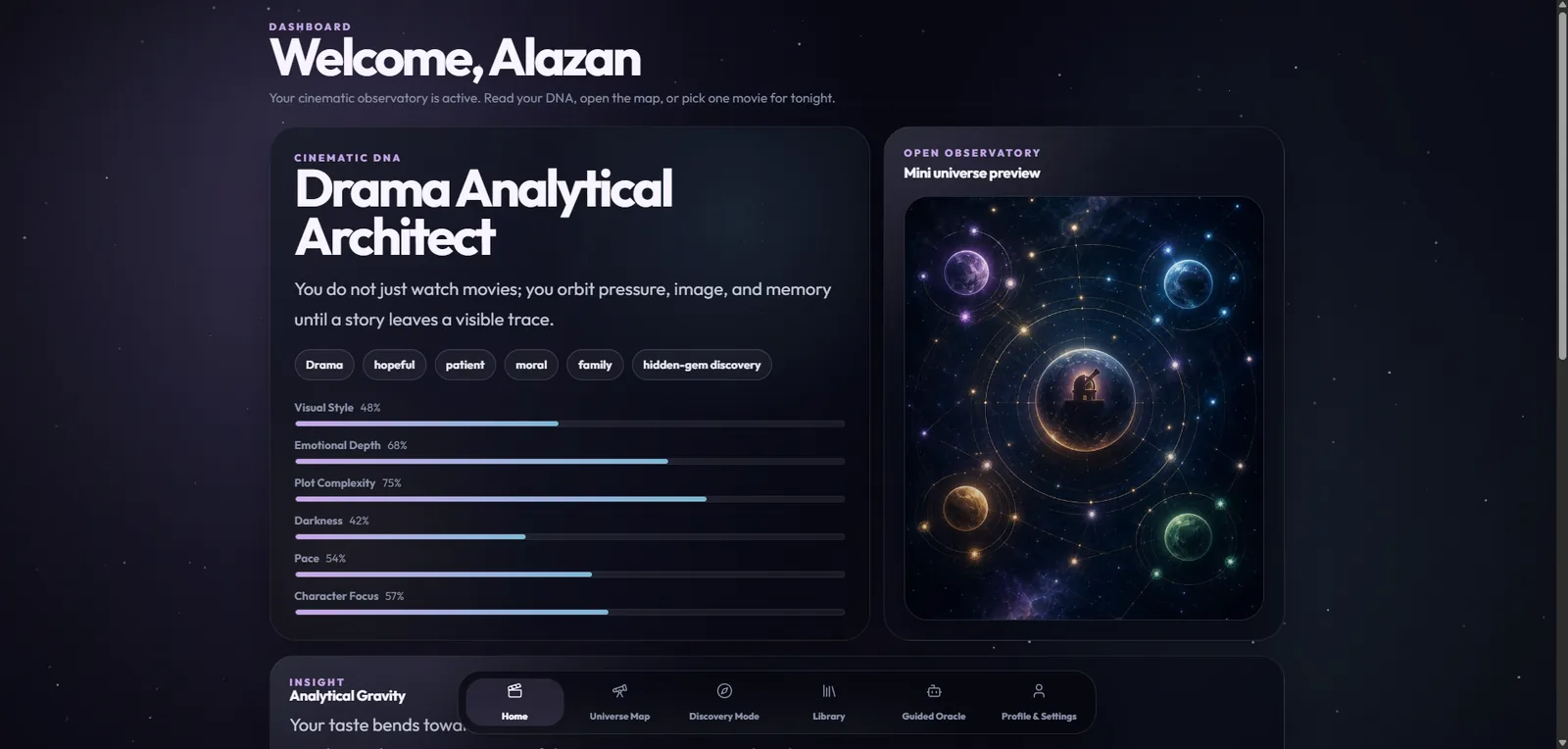
    Selected films and five guided questions produce a six-dimension cinematic profile that gives later recommendations visible context.

  2. 02

    Discovery & Universe Map

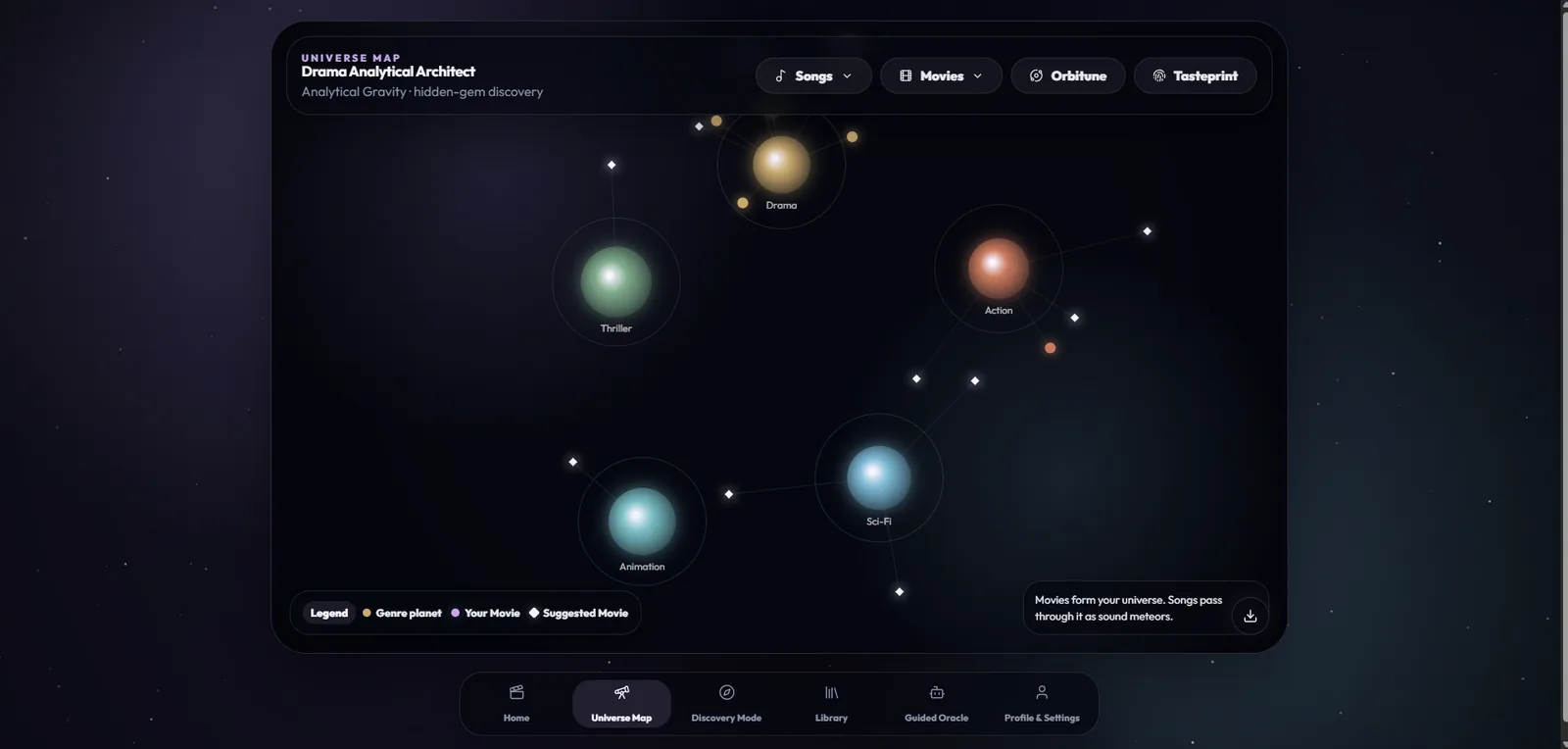
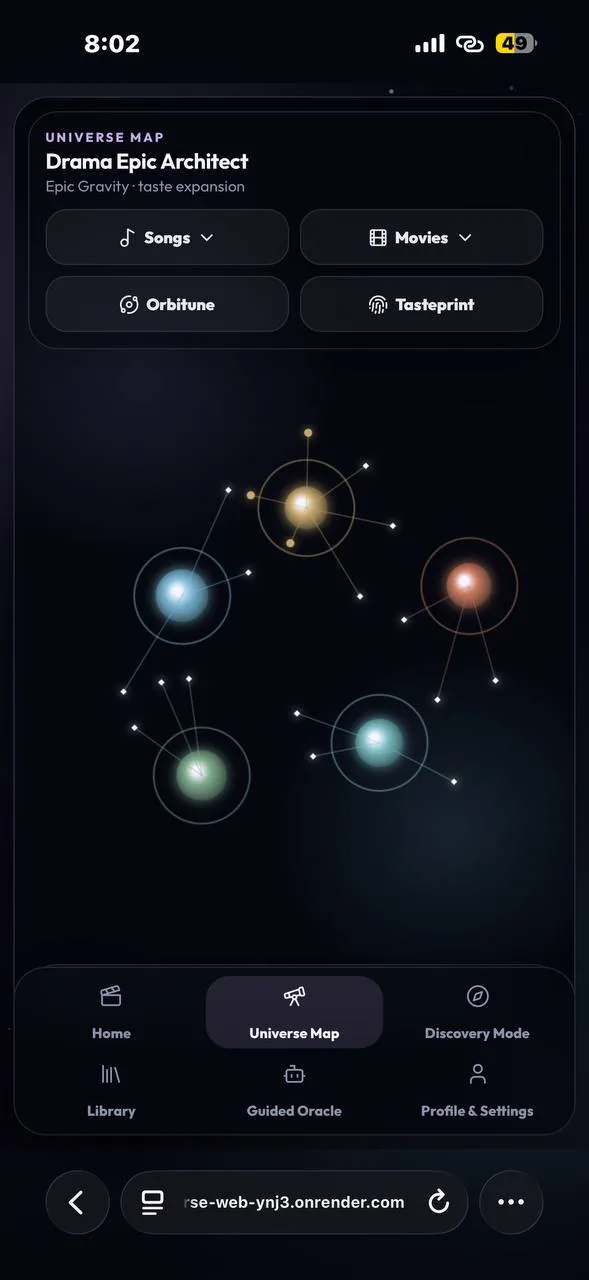
    Film recommendations, genre planets, selected titles, Orbitune signals, and song meteors are explored through one connected visual model.

  3. 03

    Library & Tasteprint

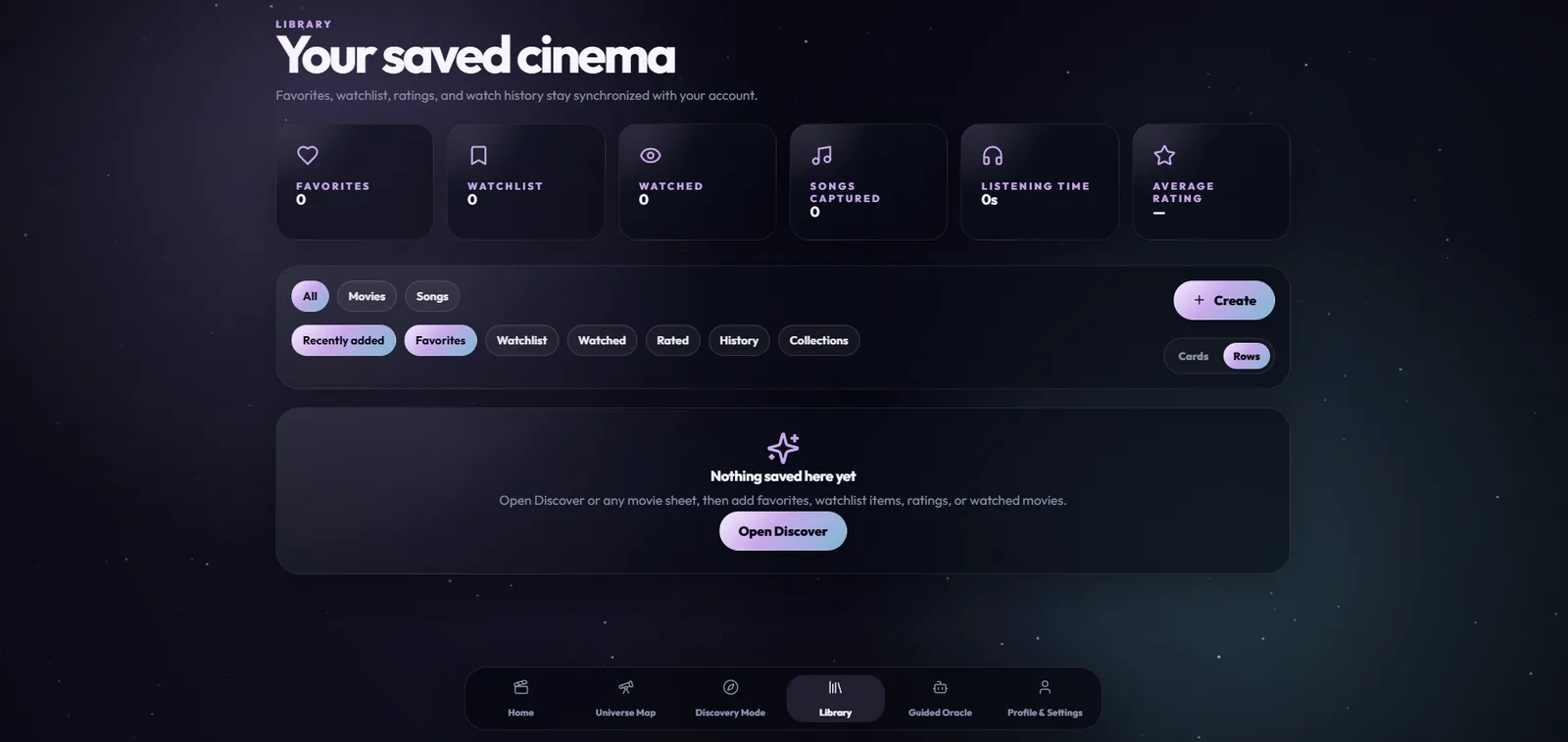
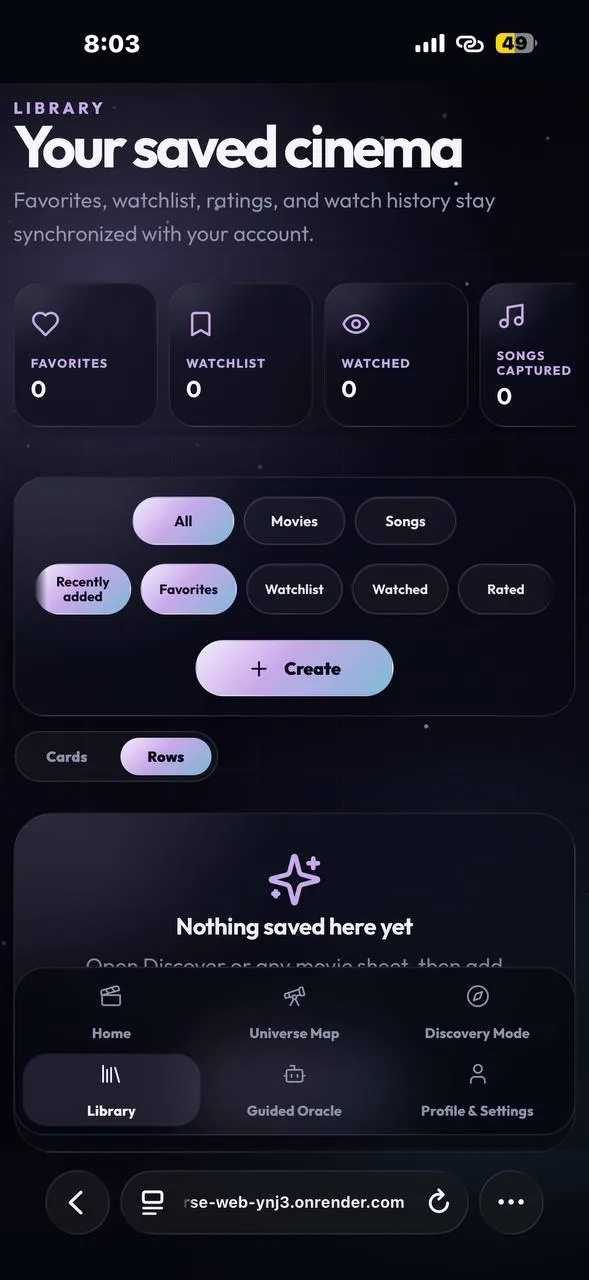
    Ratings, favorites, watchlists, playlists, collections, and mixed-media constellations reuse saved content instead of ending each interaction at a single screen.

  4. 04

    Secure Persistent State

    Authenticated server state, revision control, HttpOnly cookies, and backend API proxies protect user data and external-service credentials across sessions.

Walkthrough

Watch a taste profile become a personal media universe.

A complete walkthrough of onboarding, taste selection, cinematic DNA, personalized discovery, the Universe Map, Orbitune, and the persistent media library.

Design decisions

Three product choices that connected analysis, discovery, and organization into one experience.

01

Build the taste profile before presenting recommendations

Why?Reduces the cold-start problem and gives recommendations a foundation users can understand.

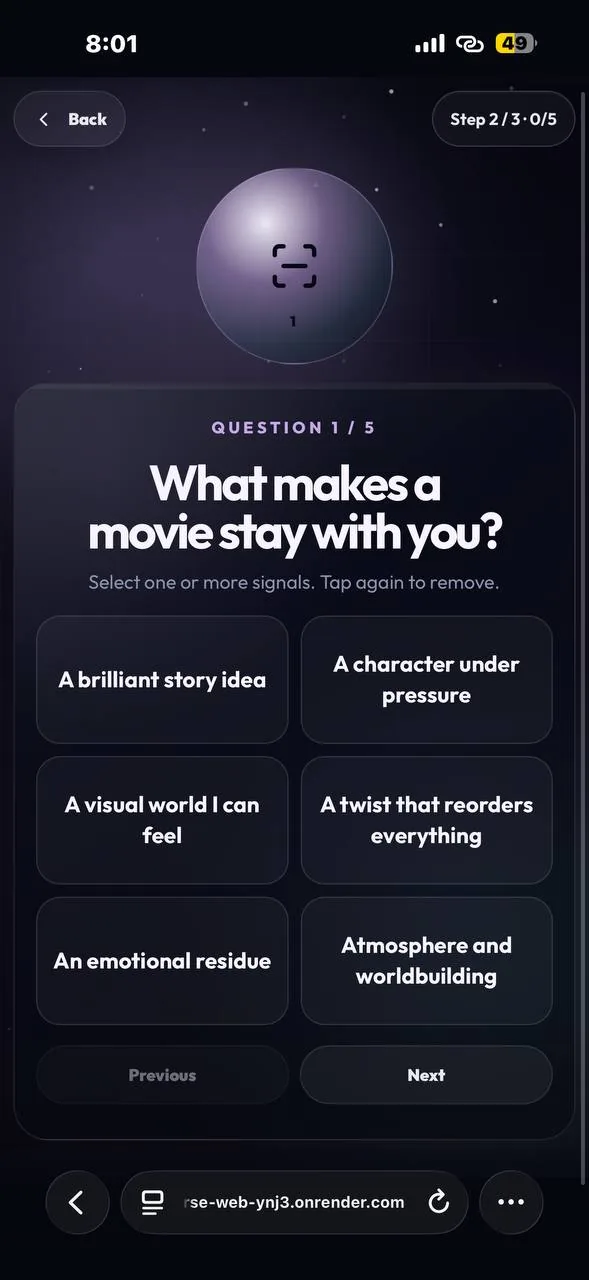
Instead of opening with generic suggestions, CineVerse asks users to select at least three films and complete five short questions. These inputs become a six-dimension DNA profile, reducing the cold-start problem and giving users a visible foundation for understanding later recommendations.

02

Connect films and music through one visual model

Why?Makes cross-media relationships explorable rather than list-based.

The Universe Map brings genre planets, selected films, suggested films, song meteors, and Orbitune signals into the same scene. Users can control labels and suggestions, edit the map’s content, move directly into connected tools, and export the universe as an image, making cross-media relationships explorable rather than list-based.

03

Reuse saved content throughout the product

Why?Reduces repeated selection and turns the library into an active workspace.

A film’s journey does not end when it is rated or saved, and a song’s journey does not end when it is captured in Orbitune. Films feed favorites, watchlists, and collections, while songs feed the map, playlists, mixed-media constellations, and Tasteprint. This reduces repeated selection and turns the library into an active workspace with media filters and card or row views.

On mobile

From Taste Scan to the CineVerse Universe

  • Mobile Taste Scan
    Mobile Taste ScanGuided preference questions adapted to a compact touch interface.
  • Mobile Universe
    Mobile UniverseThe interactive map preserves labels, controls, and one-finger navigation on mobile.
  • Mobile Library
    Mobile LibraryStatistics, filters, and saved media remain usable without horizontal page overflow.

How it's built

From the screen to the database.

  1. React + TypeScriptVite interactive client
  2. Central API ClientNo direct service calls or browser persistence
  3. NestJS APIAuth, validation, proxies, and state services
  4. Prisma ORMAtomic relational operations
  5. PostgreSQL 16Persistent user and product state

IntegrationsOMDbiTunesLast.fm

Engineering evidence

  • Secure HttpOnly access and rotating refresh cookies replace browser token storage.
  • Atomic revision control rejects stale sessions before they overwrite newer PostgreSQL state.
  • OMDb, iTunes, and Last.fm requests pass through validated backend proxies with no exposed client keys.
  • A server-validated access key protects the private interactive demo and can be rotated through deployment configuration.

Validation

  • Full-stack CI covers locked builds, Prisma generation and migrations, backend tests, API smoke tests, and protected-route behavior.
  • Playwright verifies account creation, persistence, logout/login restoration, dynamic routes, and responsive mobile layouts.
  • Security audits reject exposed API keys, direct external calls, browser persistence, and unsafe state mutations.

Outcome

A connected product that turns user choices into an explorable, organized, and shareable taste profile.

Read the full context

The result is a complete functional journey that begins with onboarding and account creation, moves through taste analysis and recommendations, and continues into film search, detailed views, visual mapping, music discovery, library management, and export. Films, songs, ratings, collections, and playlists operate as connected parts of one server-backed state rather than isolated features. The interface supports English and Arabic with LTR and RTL layouts, includes loading, error, and empty states, and adapts its main flows across desktop and mobile. The repository includes frontend, state, backend, database, API, and browser-route testing, along with a Render configuration for the web application, API, and PostgreSQL database. This supports a ready-to-run status without claiming unverified usage or commercial results. The project demonstrates the ability to combine personalized product design, explainable recommendation logic, interactive visual presentation, and full-stack persistence within one cohesive application.
Constraints

  • The demo is intentionally access-protected; credentials are shared directly with authorized reviewers.
  • External discovery features depend on third-party service availability and rate limits.
  • Desktop behavior had to remain stable while mobile layouts and map interactions were refined independently.